3 Carat Round Brilliant Cut Lab-Grown Diamond Ring | D Color · VS1 · 18K White Gold
The pinnacle of diamond cutting. Certified by the Gemological Institute of America.
Product Specifications
| Specification |
Detail |
What It Means |
| Diamond Type |
Lab-Grown |
Chemically identical to natural diamonds |
| Shape |
Round Brilliant Cut |
The world’s most popular cut — engineered for maximum sparkle |
| Carat Weight |
3.00 ct |
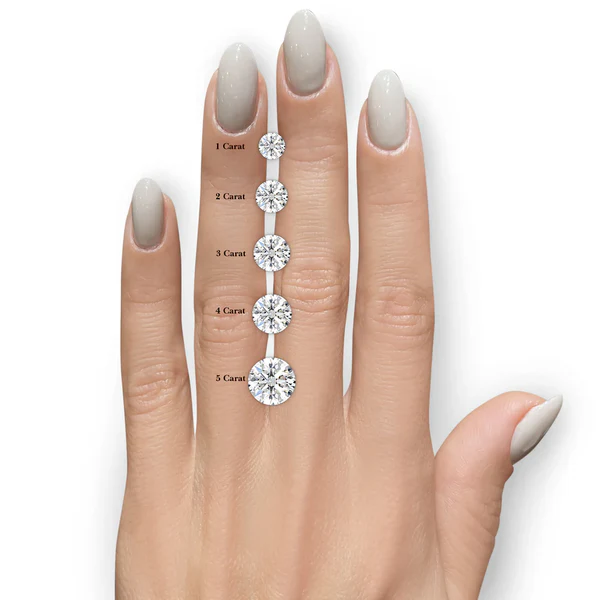
A truly impressive, show-stopping center stone |
| Cut Grade |
Excellent (EX) |
Maximum brilliance and light performance |
| Color Grade |
D Color |
Completely colorless — the finest grade possible |
| Clarity Grade |
VS1 |
Inclusions invisible to the naked eye |
| Setting |
18K White Gold |
Cool-toned, durable, and brilliantly lustrous |
| Production Time |
1–2 Weeks |
Handcrafted to order |
Shipping & Returns
Free Worldwide Shipping Every order ships free to all countries and regions — no minimum spend, no hidden fees.
Fast International Delivery All orders are dispatched via FedEx or DHL Express Priority. International shipments typically arrive within 3–5 business days. As soon as your order ships, our team will email you a tracking number so you can follow your package in real time.
30-Day Hassle-Free Returns Not completely in love with your ring? Return it within 30 days — no questions asked. We cover all return shipping costs in full.
A Complete Guide to Lab-Grown Diamonds
Lab-grown diamonds have reshaped the fine jewelry industry over the past decade. They deliver the same certified quality and brilliance as naturally mined diamonds — at a price that makes larger, higher-grade stones genuinely attainable. Here’s everything you need to know before you buy.
What Are Lab-Grown Diamonds?
Lab-grown diamonds — also called synthetic or cultured diamonds — are real diamonds, not imitations. They share the exact same physical, chemical, and optical properties as naturally mined diamonds. The only difference is their origin: they are grown in a controlled laboratory environment rather than forming deep within the earth over millions of years.
Because they can be produced at scale, lab-grown diamonds are significantly more affordable than mined stones — making a 3-carat round brilliant diamond like this one accessible without sacrificing a single point of quality.
How Are Lab-Grown Diamonds Made?
Two primary methods are used to create laboratory diamonds:
Chemical Vapor Deposition (CVD) A diamond seed is placed inside a vacuum chamber filled with carbon-rich gases. Heated to temperatures between 700°C and 900°C, carbon atoms deposit onto the seed layer by layer — gradually building up into a full diamond crystal. This method offers precise control over the diamond’s purity and growth, making it one of the most widely used techniques today.
High Pressure High Temperature (HPHT) This method replicates the natural diamond formation process by applying extreme pressure and heat to a diamond seed, causing the crystal to grow outward. It closely mimics the intense conditions found hundreds of miles beneath the Earth’s surface.
Once grown, the rough diamond is expertly cut and polished using the same techniques applied to naturally mined stones. There is theoretically no upper limit to the size or quantity of diamonds that can be produced this way.
Are Lab-Grown Diamonds More Ethical?
It’s one of the most common questions buyers ask — and the honest answer involves trade-offs on both sides.
Supply Chain Transparency Lab-grown diamonds are far easier to trace from creation to purchase, offering greater confidence around worker conditions and human rights. This is a meaningful advantage over some mined diamonds, where verifying the supply chain can be difficult.
Environmental Considerations Lab diamond production is energy-intensive. Some studies suggest lab-grown diamonds generate higher greenhouse gas emissions per carat than mined diamonds — though these figures vary significantly depending on the energy source, production method, and country of manufacture. It’s also worth noting that much of the widely cited research has been funded by the natural diamond mining industry. Natural diamond mining carries its own environmental costs, including land disruption, water use, and ecosystem impact.
Economic Impact on Mining Communities Natural diamond mining plays a significant economic role in countries like Botswana, which has relied on diamond revenue since 1967 to build schools, hospitals, and infrastructure — becoming one of the fastest-growing economies in the world as a result. Lab-grown diamonds do not contribute to these local economies.
Neither option is perfect. What lab-grown diamonds do offer is greater transparency, lower cost, and freedom from conflict-origin concerns.
Can You Tell a Lab-Grown Diamond From a Natural One?
No — and neither can most trained gemologists without specialized equipment. Lab-grown and natural diamonds are physically and chemically identical. Standard jewelry tools cannot distinguish between them; only advanced spectroscopic analysis can reveal any difference.
Every lab-grown diamond we sell comes with an official GIA (Gemological Institute of America) grading report, which fully documents the stone’s origin, cut, color, clarity, and carat weight — giving you complete transparency and lasting peace of mind with your purchase.
Do the 4Cs Still Matter for Lab-Grown Diamonds?
Absolutely — and they matter just as much as they do for natural diamonds. Lab-grown diamonds are not automatically flawless. Inclusions can form during the growth process, and quality varies widely between stones. The 4Cs are your most reliable guide to understanding what you’re buying:
Cut — The single most important factor for a diamond’s beauty. The round brilliant cut is specifically engineered with 58 precisely angled facets to reflect the maximum amount of light. This ring carries an Excellent (EX) cut grade — the highest possible — delivering unrivaled fire and brilliance.
Color — Graded from D (completely colorless) to Z (visibly yellow). This stone is D color — the rarest, most prized grade, with absolutely no color tint whatsoever. In an 18K white gold setting, a D color diamond appears strikingly bright and pure.
Clarity — At VS1, inclusions are extremely difficult to detect even under 10× magnification and completely invisible to the naked eye. An exceptional clarity grade that ensures a clean, beautiful stone.
Carat — At 3 carats, this round brilliant cut makes an undeniable statement. The round shape is the most classic and universally flattering diamond shape, beloved for its timeless appearance and extraordinary light performance.
Is a Lab-Grown Diamond Right for You?
If you want the very best combination of size, certified quality, and value, a 3-carat round brilliant lab-grown diamond is an exceptional choice. You receive a genuine D color, VS1 clarity, Excellent cut diamond — backed by a full GIA certificate — at a fraction of the cost of a comparable mined stone.
The round brilliant cut has been the world’s most popular diamond shape for over a century, and for good reason. Its 58-facet design produces more brilliance and sparkle than any other cut. Paired with the cool elegance of 18K white gold, this ring is a timeless, investment-worthy piece built to be treasured for generations.


 Price range: $1,450.00 through $4,220.00
 Price range: $1,480.00 through $4,290.00


Reviews
There are no reviews yet.